

- Introduction
- Why does funding readiness matter?
- What do invoice finance providers really assess?
- What prevents businesses securing funding?
- Why does sales ledger quality matter?
- Five ways businesses can improve funding readiness
- Case study: Preparing a healthcare recruitment business for invoice finance
- How can specialist support help?
- Summary
- FAQs
Introduction
For many business leaders, applying for invoice finance begins when cashflow pressure has already started to build. The assumption is often that approval depends primarily on turnover, profitability or the value of the sales ledger. In reality, funders look much deeper than that.
Invoice finance providers look beyond turnover and the value of your invoices. Before approving funding, they assess the quality of your sales ledger, the strength of your credit control processes and how effectively your business manages working capital. At itsettled, we’ve helped businesses become funding ready for more than 15 years, and recently discussed what funders are seeing with Emma Booth, Head of Relationship Management at Ultimate Finance.
One message came through clearly: funding readiness starts long before a funding application is submitted.
Businesses with strong debtor management, disciplined credit control and healthy working capital are not only easier to approve for funding, they are often more prepared to handle challenges to begin with.
Why does funding readiness matter?
Invoice finance is one of the most effective ways for businesses to unlock cash tied up in unpaid invoices.
Yet invoice finance is often overlooked because many business owners are unfamiliar with how it works and the value it can deliver. Instead, traditional funding options such as loans and overdrafts tend to dominate the conversation.
This is not helped by the challenges UK businesses are currently facing, as Emma explains: “Our customers are currently navigating a challenging environment shaped by economic uncertainty, rising costs, and tighter liquidity. As a result, many businesses are being required to operate with greater financial efficiency, while maintaining stronger control and oversight of their debtor books to protect cashflow and minimise risk.”
Maintaining a healthy debtor book has become more important than ever. “Effective cashflow and debtor management is critical for mid-sized businesses, as delays in customer payments can quickly impact working capital and day-to-day operations.”
For many businesses, invoice finance should be seen as a strategic working capital tool.
“Invoice finance helps businesses maintain control of their debtor book to ensure predictable cashflow, whilst allowing them to unlock cash tied up in invoices, improving liquidity and supporting ongoing growth.”
Emma Booth, Head of Relationship Management, Ultimate Finance
What do invoice finance providers really look for?
One of the biggest misconceptions is that lenders simply review the value of unpaid invoices. In practice, they are assessing confidence.
Confidence that:
- invoices are valid
- customers will pay
- collections processes are effective
- reporting is accurate
- management understands its sales ledger
What prevents businesses securing invoice finance?
Over many years working with invoice finance providers, we’ve seen the same issues appear repeatedly.
- Excessive aged debt
Businesses with significant debt over 90 or 120 days raise concerns around recoverability. A useful benchmark is to keep debt over 90 days below 10% of the total sales ledger.
- High debtor days
If Day Sales Outstanding (DSO) is consistently well above agreed payment terms, it often indicates wider operational issues. Read our guide on how to calculate debtor days for your business.
- Poor order-to-cash processes
Late invoicing, missing paperwork, invoice disputes and weak documentation all reduce confidence in the quality of the ledger.
- Reactive credit control
Many businesses only begin chasing invoices once they become significantly overdue. The strongest businesses have structured collections processes that begin before invoices fall due.
- Weak reporting
Funders want visibility, and if businesses cannot quickly produce accurate aged debtor reports, dispute logs or customer analysis, confidence falls.
- Customer quality
Funders also assess the quality of the debtor book itself. Poor customer payment behaviour or excessive customer concentration may reduce funding availability.
Why does sales ledger quality matter?
Poor ledger quality affects far more than funding. It creates:
- weaker working capital
- increased borrowing pressure
- poorer forecasting
- supplier payment delays
- reduced financial flexibility
Funding readiness is therefore really a symptom of something bigger which is working capital health.
Five ways business can improve funding readiness
1. Audit your sales ledger
Understand:
- debt over 30, 60 and 90 days
- disputed invoices
- credit notes
- customer concentrations
2. Strengthen your collections process
Implement:
- documented credit policies
- consistent reminder schedules
- escalation procedures
- pre-due-date collections
Strong process creates confidence.
3. Reduce aged debt
The cleaner the ledger, the stronger your funding position. Reducing aged debt also improves working capital and cashflow before funding is even considered.
4. Resolve disputes quickly
Queries delay payment. The faster they are resolved, the stronger the debtor book becomes.
5. Demonstrate control
Funders want to see:
- reliable reporting
- consistent collections
- documented procedures
- management oversight
Businesses that demonstrate control often secure better outcomes.
Case study: Preparing a healthcare recruitment business for invoice finance
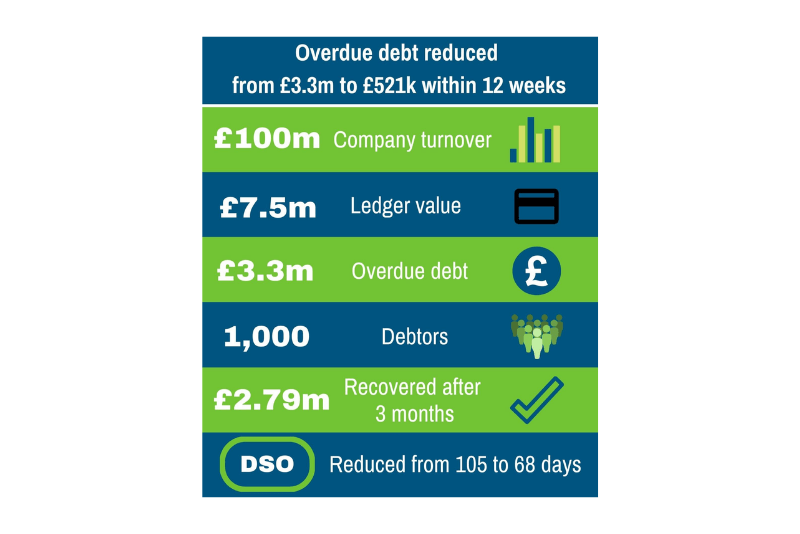
One London-based healthcare recruitment business with a turnover of £100 million needed to move from a platform funding solution to a traditional invoice finance facility after its existing arrangement was no longer providing the working capital required to support growth.
Although the business had a £7.5 million sales ledger, the prospective funder identified significant aged debt and weaknesses in the ledger that needed to be addressed before the new invoice finance facility could be approved. Debt over 120 days had reached £1.5 million, total overdue debt exceeded £3.3 million, and Days Sales Outstanding (DSO) had risen to 105 days. The business was also managing more than 7,000 outstanding invoices with an under-resourced credit control team.
Working alongside the client and the prospective funder, itsettled by Credebt implemented a structured improvement programme. We provided short-term collections support, reviewed and strengthened credit control procedures, introduced formal credit policies, assisted with recruitment, and worked closely with the internal team to resolve historic customer queries and improve collections performance.
Within just three months, DSO reduced from 105 to 68 days, debt over 120 days fell from £1.5 million to £300,000, and total overdue debt reduced from £3.3 million to £521,000. The business successfully transitioned to its new invoice finance facility, leaving it with stronger working capital, a healthier sales ledger and an in-house team equipped to sustain the improvements.
How specialist support can help
Emma also explained how working alongside specialists such as itsettled strengthens the support Ultimate Finance provides.
Rather than simply focusing on funding, specialist working capital reviews help businesses improve:
- collections performance
- aged debt
- process discipline
- documentation
- confidence in the sales ledger
Ultimately, that benefits both the client and the funder.
“Working with a specialist like itsettled by Credebt really strengthens the overall support we’re able to provide, bringing an added layer of expertise and independent insight when it’s needed most.”
Summary
Invoice finance providers are looking for more than a strong turnover – they’re looking for confidence in your ability to manage cashflow. Businesses with accurate reporting, disciplined credit control and a healthy sales ledger are more likely to secure funding and achieve better funding outcomes. At itsettled, we help businesses strengthen these foundations, so they are funding ready before they even submit an application.
Frequently asked questions
What do invoice finance providers look for?
Funders assess ledger quality, debtor ageing, collections processes, reporting accuracy and customer payment behaviour alongside the value of invoices.
Can businesses improve their chances of approval?
Yes. Improving debtor management, reducing aged debt and strengthening credit control processes all increase funding readiness.
Details
What is a good sales ledger for invoice finance?
Although every lender has different criteria, businesses with lower levels of aged debt, predictable collections and strong documentation are generally viewed more favourably.
Is invoice finance only suitable for distressed businesses?
No. Many successful, profitable businesses use invoice finance as a strategic tool to improve working capital and support growth.
Is your business funding ready?
Many businesses are closer to securing funding than they realise.
Often, the difference is not the quality of the business, it’s the quality of the sales ledger.
If you’d like to understand how funders might view your debtor book, or identify practical improvements before applying for finance, our Working Capital Health Check provides a confidential review of your sales ledger, collections processes and funding readiness.
For more information on Ultimate Finance, visit: https://ultimatefinance.co.uk/