

Contents
- What causes cashflow problems?
- What happens if cashflow issues are ignored?
- How can outsourced credit control specialists solve business cashflow problems?
- Why are outsourced credit control specialists often more effective than hiring?
- Case Study: Restoring cashflow after a business acquisition
- Next steps
- FAQs
Business cashflow problems are often caused by overdue invoices, poor credit control processes and rising debtor days. Outsourced credit control specialists like itsettled help businesses unlock working capital by recovering overdue debt, reducing Days Sales Outstanding (DSO) and strengthening credit management processes – all within a focused three-month intervention that delivers both immediate and long-term results.
Every business leader knows that profit doesn’t pay the bills, cash does. Yet many otherwise successful businesses find themselves under pressure because too much money is tied up in unpaid invoices.
Government research shows businesses spend around 133 million hours every year chasing overdue payments, while the average mid-market business operates with a DSO of around 61 days, which is more than double standard 30-day payment terms. That represents valuable working capital sitting in customers’ bank accounts instead of your own. What’s more, the latest ICAEW Business Confidence Monitor shows that business confidence has fallen to its lowest level since late 2022, with concerns over energy costs, labour costs and late payments all increasing.
Fortunately, cashflow problems are rarely unsolvable. The right expertise, processes and focused action can quickly improve collections while protecting valuable customer relationships.
What causes business cashflow problems?
Cashflow problems are often symptoms of weaknesses elsewhere in the finance function, rather than a lack of sales.
Common causes include:
- Customers consistently paying beyond agreed terms.
- High levels of aged debt.
- No formal credit control policy.
- Invoice queries taking weeks to resolve.
- Under-resourced finance teams.
- Rising Days Sales Outstanding (DSO).
- Over-reliance on invoice finance.
As overdue invoices accumulate, businesses have less cash available to pay suppliers, invest in growth or fund payroll. Finance teams spend more time reacting to problems instead of preventing them.
What happens if cashflow issues are ignored?
Cashflow problems rarely improve without intervention. Ignoring the warning signs can create a cycle that becomes increasingly difficult to break.
| Cashflow issue | Business impact |
| High aged debt | Reduced working capital |
| Rising DSO | Greater borrowing requirements |
| Slow invoice queries | Delayed payments |
| Weak credit policies | Inconsistent collections |
| Poor forecasting | Difficult cash planning |
| Reliance on invoice finance | Higher funding costs |
For many businesses, these issues also affect relationships with suppliers, lenders and invoice finance providers, creating additional pressure at board level.
How can outsourced credit control specialists solve business cashflow problems?
An outsourced credit control specialist provides immediate expertise without the delay and cost of recruiting additional staff.
Here are ten practical ways they can improve your cashflow.
1. Analyse your sales ledger properly
Understanding where debt is sitting allows you to prioritise collections and identify recurring payment issues.
2. Focus on the highest-value overdue accounts
Not every invoice should receive the same attention. Prioritising high-value debts delivers quicker improvements in working capital.
3. Resolve disputes quickly
Many overdue invoices remain unpaid because customer queries have stalled. Resolving these issues promptly removes barriers to payment.
4. Reduce Days Sales Outstanding (DSO)
Reducing DSO by even a few days can release significant amounts of cash back into the business.
5. Introduce clear credit policies
A documented credit policy ensures customers receive consistent communication throughout the payment lifecycle.
6. Improve collection processes
Effective collections rely on structured communication, clear escalation procedures and regular follow-up—not aggressive debt collection.
7. Support your existing finance team
An outsourced specialist works alongside your team, allowing internal staff to focus on strategic finance activities while experienced professionals manage intensive collections.
8. Strengthen reporting
Better reporting gives finance directors greater visibility over debtor performance, collection activity and future cash flow.
9. Reduce reliance on expensive funding
Improving collections often reduces dependence on invoice finance or other short-term borrowing, lowering funding costs.
10. Leave lasting improvements
The best outsourced credit control providers don’t simply recover overdue invoices – they leave behind stronger processes, better reporting and sustainable improvements.
Why are outsourced credit control specialists often more effective than hiring?
Experienced specialists deliver results immediately. Recruiting experienced credit control professionals can take months. During that time, overdue debt continues to grow and cashflow remains under pressure. By contrast, outsourced specialists bring proven systems, experienced people and established processes from day one.
Our team has recovered more than £1bn for UK businesses since 2009. Every member of our team has at least 20 years’ experience in credit management or invoice finance, allowing us to identify opportunities and resolve issues quickly. More than 90% of our projects have resulted in funders being repaid in full or recoveries exceeding expectations.
Read our guide to working with a credit management partner.
Case Study: Restoring cashflow after a business acquisition
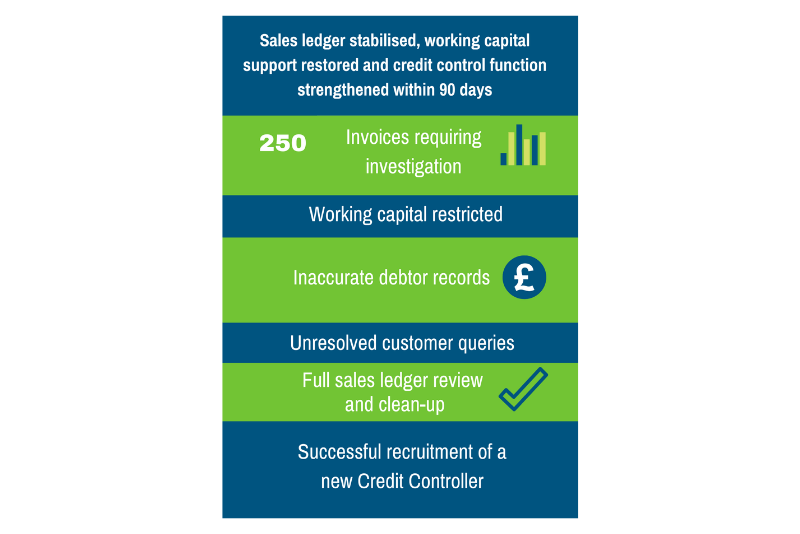
When a commercial cleaning contractor employing around 250 people was acquired by a new owner, the business expected to inherit a growing customer base and strong recurring revenue. Instead, it uncovered a sales ledger in serious disarray.
An invoice finance provider referred the business to itsettled after concerns over the quality of the sales ledger. This had meant further working capital support had been restricted by mutual agreement until the underlying issues could be resolved.
Our initial review revealed a series of long-standing problems that were preventing the business from collecting cash efficiently. Around 250 invoices required investigation or correction, invoices had frequently been raised in advance rather than in arrears, creating unnecessary customer disputes, and debtor records were inaccurate. Customer queries had accumulated over time, leaving the finance team overwhelmed and unable to focus on proactive collections.
Working as an extension of the client’s finance team, we quickly implemented a structured recovery programme. We carried out a full review and clean-up of the sales ledger, corrected historic invoicing errors, resolved outstanding customer disputes and strengthened debtor management processes. Throughout the project, we maintained regular communication with the invoice finance provider, ensuring confidence was rebuilt as improvements were delivered.
One of the biggest factors in the project’s success was our collaborative approach. Rather than taking control away from the business, our consultant worked alongside the existing team, helping them prioritise actions, achieve early wins and build momentum. What initially felt like an overwhelming backlog became a manageable recovery programme with clear progress every week.
To ensure the improvements continued long after our engagement ended, we also supported the recruitment of a dedicated Credit Controller, helping the business establish the people and processes needed for sustainable credit management.
Results achieved within 90 days
- Stabilised and regained control of the entire sales ledger.
- Corrected approximately 250 historic invoicing issues.
- Resolved long-standing customer disputes and outstanding queries.
- Significantly improved collections performance and cash generation.
- Restored confidence with the invoice finance provider, allowing normal funding support to resume.
- Recruited a dedicated Credit Controller to maintain the improvements.
By the end of the three-month intervention, responsibility for collections had been successfully handed back to a stronger in-house finance team. The business was left with a cleaner sales ledger, improved working capital, more robust credit control processes and a sustainable platform for future growth.
Next steps
By improving credit control, reducing debtor days, resolving invoice queries and implementing structured collection processes, businesses can unlock significant working capital without damaging customer relationships.
At itsettled, we work as an extension of your finance team during an intensive three-month programme designed to reduce aged debt, improve cashflow and leave your business with stronger credit management processes long after the engagement has finished.
If overdue invoices are restricting growth or increasing funding pressure, we’re ready to help you take back control of your cashflow.
Frequently asked questions
How can outsourced credit control improve cashflow?
Outsourced credit control accelerates collections, reduces overdue invoices, improves DSO and releases working capital back into the business.
What is Day Sales Outstanding (DSO)?
DSO measures the average number of days it takes a business to collect payment after making a sale. A lower DSO generally indicates healthier cashflow.
How long does it take to improve cashflow?
While every business is different, itsettled’s intervention is designed to deliver measurable improvements within 90 days while embedding long-term credit control processes.
Will outsourced credit control damage customer relationships?
No. Professional credit management focuses on clear communication, resolving issues quickly and maintaining positive commercial relationships throughout the collection process.
Will outsourced credit control damage customer relationships?
No. Professional credit management focuses on clear communication, resolving issues quickly and maintaining positive commercial relationships throughout the collection process.
What is DSO?
DSO measures the average number of days it takes a business to collect payment after making a sale. A lower DSO generally indicates healthier cashflow.
Author

Glen Morgan FCICM (Grad)
Founder, itsettled by Credebt
Glen Morgan is one of the UK’s leading receivables management specialists, with more than 30 years’ experience in credit management and invoice finance. Through Credebt, he has helped recover over £1bn for UK businesses and has advised organisations on improving working capital, reducing debtor days and strengthening credit control practices.