

In our experience, in order to solve cashflow issues, businesses first need to identify where cash is becoming trapped. If the problem is caused by slow customer payments, rising aged debt or poor credit control, improving collections and debtor management can release working capital without simply increasing borrowing.
The right solution depends on the cause. For example, a business experiencing cashflow pressure because customers are paying late needs a different response from one suffering from falling sales, excessive costs or an unsustainable debt burden. For businesses with healthy revenues but weak cash conversion, the sales ledger is often the best place to start.
Contents
- What causes cashflow issues?
- How can you identify the cause of a cashflow issue?
- How can you improve cashflow quickly?
- How does aged debt affect cashflow?
- How can better credit control solve cashflow issues?
- When should you get external support?
- How does itsettled solve cashflow problems?
- What results can improved debtor management deliver?
- Next steps
- FAQs
What causes cashflow issues?

Cashflow pressure can affect profitable businesses as well as loss-making ones.
Common causes include:
- Customers paying late.
- High levels of aged debt.
- Rapid growth.
- Weak credit control.
- Invoice disputes.
- Poor cashflow forecasting.
- Customer concentration.
- Seasonal trading patterns.
- Increasing operating costs.
- High borrowing or funding costs.
- Mismatch between supplier and customer payment terms.
The first step is therefore diagnosis, not simply collections.
How can you identify the cause of a cashflow issue? Start with four questions.
1. Is the business generating sufficient revenue?
If sales are declining materially, collections alone cannot solve the underlying problem.
2. Is the business profitable?
Strong cash collections cannot permanently compensate for an unsustainable cost base.
3. Where is cash currently tied up?
Look at receivables, inventory and other areas of working capital.
4. Are customers paying when expected?
Review payment terms, DSO, overdue debt and customer payment behaviour.
For businesses with a significant sales ledger, this fourth question can reveal substantial opportunities.
How can you improve cashflow quickly?
If customer payments are the problem, focus on the areas most likely to release cash.
1. Review the aged-debt report
Understand exactly what is sitting at 30, 60, 90 and 100+ days. Don’t simply look at the total debtor balance.
2. Prioritise by value and collectability
The oldest invoice isn’t automatically the best place to start. Focus effort where intervention is most likely to generate meaningful cash.
3. Identify unresolved queries
Separate genuine collections issues from invoices that cannot be paid because something is wrong.
4. Speak to customers
Establish what is preventing payment and secure clear commitments where possible.
5. Escalate appropriately
High-value or high-risk accounts should have clear escalation routes.
6. Measure the starting position
Record DSO, aged debt and outstanding queries.
Without a baseline, it is difficult to demonstrate whether the situation is improving.
How does aged debt affect cashflow?
Aged debt represents sales that have been made but have not yet converted into cash.
That matters because the business may already have incurred costs associated with delivering those sales.
For example, it may already have paid:
- Employees.
- Suppliers.
- Freight.
- Materials.
- Tax.
- Overheads.
If the customer then pays significantly later than expected, the business has to fund that gap. As aged debt grows, businesses may need to use more of an overdraft or invoice finance facility simply to support normal operations.
How can better credit control solve cashflow issues?
Strong credit control improves the speed and consistency with which invoices become cash. That means looking across the whole order-to-cash process rather than focusing solely on overdue accounts.
Areas to examine include:
Before the sale
- Customer credit assessment.
- Credit limits.
- Payment terms.
At invoicing
- Invoice accuracy.
- Purchase-order requirements.
- Supporting documentation.
After invoicing
- Collections timetable.
- Customer communication.
- Query ownership.
- Escalation procedures.
Management
- DSO reporting.
- Aged-debt analysis.
- Customer concentration.
- Collections KPIs.
- Cash visibility.
A weakness at any stage can delay payment later.
When should you get external support?
External support becomes particularly valuable when:
- The scale of aged debt exceeds the capacity of the existing team.
- More than 10% of the ledger is over 100 days old.
- DSO is materially beyond payment terms.
- Queries have accumulated.
- The business lacks formal credit policies.
- An invoice finance provider is concerned.
- Management needs improvement quickly rather than gradually.
A temporary intervention can provide experienced resource without committing the business to a permanent increase in headcount. Read our guide to working with a credit management partner.
How does itsettled solve cashflow issues?
Where cashflow pressure is being caused by poor receivables performance, itsettled uses a focused three-month process to unlock cash and strengthen the underlying credit control function.

Month 1: unlock working capital
We review the sales ledger, identify where cash is trapped and begin intensive collections activity.
The priority is understanding the true position and generating measurable improvement.
Month 2: resolve the causes
We address customer queries and operational issues, develop credit policies and collections procedures, and identify any gaps in team structure or resource.
Month 3: embed the improvements
We establish stronger processes and support the internal team so responsibility can be handed back with better systems and controls in place.
Our wider support can also include order-to-cash reviews, customer negotiations, recruitment support and invoice-finance assistance.
The objective isn’t simply to collect today’s overdue invoices, it’s to reduce the likelihood of tomorrow’s invoices becoming the next aged-debt problem.
What results can improved debtor management deliver?
A plumbing supplies business with £18 million turnover approached itsettled after twice failing to secure the invoice finance facility it needed.
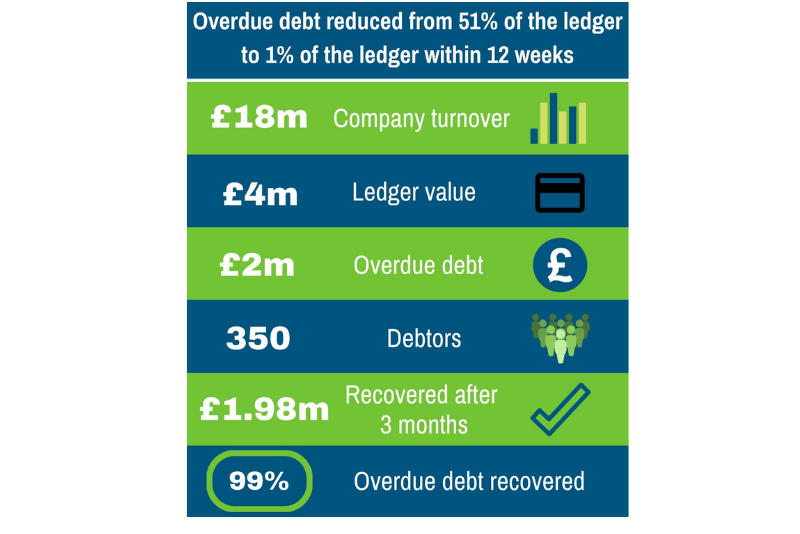
During the three-month intervention, itsettled worked alongside the internal finance team, managed collections, addressed longstanding queries, implemented formal policies and procedures and advised on team structure.
The project then handed responsibility back to the strengthened internal team. This is an important distinction as the result wasn’t simply more cash collected, it was greater control of the sales ledger and a more sustainable credit management function.
Can borrowing solve a cashflow issue?
Sometimes additional funding is entirely appropriate.
Invoice finance, overdrafts and other facilities can provide valuable working capital. However, borrowing and collections solve different problems.
If a business has substantial collectible cash sitting in overdue receivables, increasing borrowing without addressing the ledger may treat the symptom rather than the cause.
For that reason, finance leaders should understand why cash is tight before deciding how best to solve it.
Next steps
If cashflow is under pressure, start by establishing the facts:
- Calculate your current DSO.
- Review debt at 30, 60, 90 and 100+ days.
- Identify disputed and queried invoices.
- Review customer concentration.
- Compare actual payment behaviour with agreed terms.
- Assess whether the credit control team has sufficient capacity.
- Identify weaknesses in your collections process.
If the sales ledger is part of the problem, early action can help release cash and prevent aged debt continuing to grow.
itsettled’s typical three-month intervention combines immediate collections with longer-term improvements to people, policies and processes.
Frequently asked questions
How can I solve cashflow issues quickly?
First identify the cause. If cash is trapped in overdue customer invoices, prioritising high-value collectible debt, resolving queries and strengthening collections can improve working capital.
Can a profitable business have cashflow problems?
Yes. A business can report a profit while experiencing cash pressure if customer payments arrive significantly later than the costs associated with delivering those sales.
How does late payment affect cashflow?
Late payment delays the conversion of sales into usable cash, increasing the amount of working capital the business must fund.
Can reducing DSO improve cashflow?
Yes. Reducing the average time customers take to pay can accelerate cash receipts and reduce the amount of money tied up in receivables.
Should I borrow money to solve a cashflow problem?
Funding may be appropriate, but first establish why cash is under pressure. If substantial cash is trapped in overdue invoices, improving collections may form part of the solution.
Why choose itsettled?
Recovering more than £1 billion has given our team experience across manufacturing, recruitment, wholesale, construction and professional services. We’ve seen first-hand how poor credit control develops, and more importantly, how to fix it quickly.
We regularly support businesses where high invoice volumes and extended payment terms can place significant pressure on working capital.
Author

Glen Morgan FCICM (Grad)
Founder, itsettled by Credebt
Glen Morgan is one of the UK’s leading receivables management specialists with more than 30 years’ experience in credit management and invoice finance. Through Credebt, he has helped recover over £1bn for UK businesses, advised organisations on improving working capital and reducing debtor days, and has contributed to the wider credit management profession through his work with the Chartered Institute of Credit Management and UK Government initiatives on late payment.